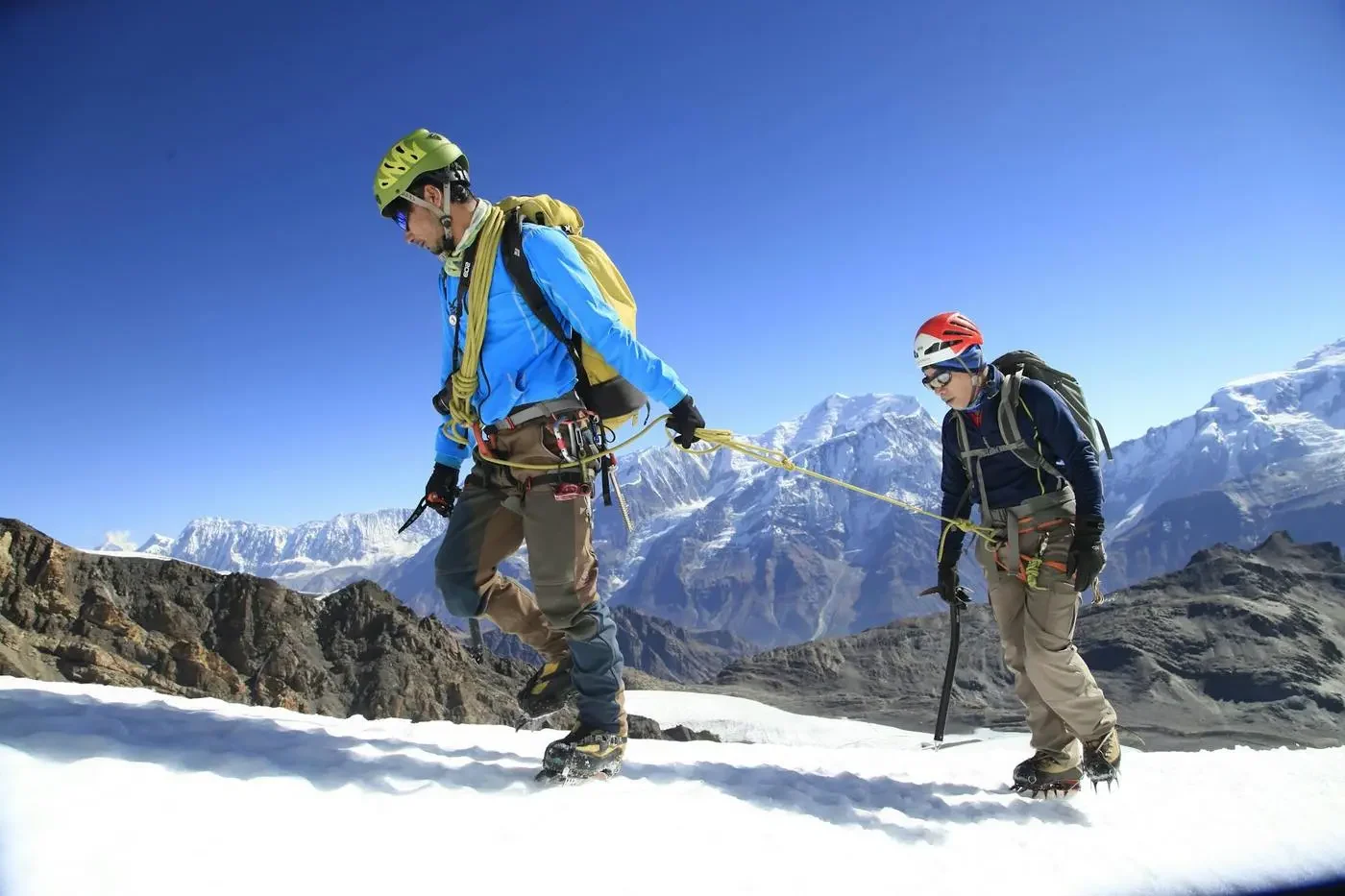
Double 8000er Exped (Everest + Lhotse)

Trip Difficulty: Extreme

Trip Days:60

Max Elevation: 8848.86m

Daily Activity: 7-8 hours Trek

Trip Starts: Lukla

Trip Ends: Lukla
The Double 8000er Expedition – Everest & Lhotse is one of the rarest achievements in Himalayan mountaineering: climbing two 8,000-meter giants in a single season, using the same expedition infrastructure, the same acclimatization rotations, and the same high-camp chain that leads into the “death zone.”
This combined objective is possible because Mount Everest and Mount Lhotse share the same approach and much of the same climbing route from Everest Base Camp through the Khumbu Icefall, across the Western Cwm, and up the Lhotse Face to the South Col area. From there, the routes diverge for the final summit pushes—Everest along the Southeast Ridge, and Lhotse via a steeper line toward the summit (often described in relation to the Lhotse Face and couloir systems depending on conditions).
At Kudos Exped, we present this trip as what it truly is: not “Everest plus an add-on,” but a fully integrated double-peak expedition designed for highly experienced climbers who want to maximize a single season in the Khumbu and aim for a historic double summit.
Why climbers choose the Everest + Lhotse double
There are three core reasons this expedition exists:
- Shared route efficiency
Because both peaks share the same expedition approach and camps for much of the route, climbers can attempt Lhotse after completing Everest without restarting the entire expedition from scratch. - One acclimatization cycle, two 8,000-meter opportunities
A proper Everest expedition builds deep acclimatization through rotations and time above 7,000m. In a double-peak plan, that acclimatization can position the climber for a second summit attempt (Lhotse) during the same weather window strategy—if strength, health, and conditions allow. - Elite-level challenge and legacy
Some operators describe the Everest–Lhotse double as a “double summit” feat attempted within a very tight time window from the South Col staging point. Regardless of the exact timing strategy, completing both in one season places climbers among a small group of high performers.
Trip Snapshot
Expedition Type: Two 8,000m summits (combined)
Peaks:
- Mount Everest – official height 8,848.86m
- Mount Lhotse – 8,516m
Route Concept: Shared approach through Khumbu Icefall and Western Cwm; staged from South Col area with route divergence above the shared line.
Best Seasons: Spring (April–May) is the classic summit window; autumn is less common for Everest commercial double attempts.
Who It’s For: Experienced 7,000m/8,000m climbers seeking a top-tier Himalayan objective
What Makes the Everest & Lhotse Double 8000er Expedition Unique
1) Two world-class peaks that are physically connected—but strategically different
Everest and Lhotse sit in the same massif and are connected by the South Col region. On paper, that connection makes the combo look straightforward. In real life, it’s the opposite: the expedition is unique because you’re combining two different summit styles.
- Everest is a long summit push with heavy exposure time in the death zone and a complex traffic environment during prime windows.
- Lhotse is widely described as steeper and more direct in its upper section, demanding strong movement economy and stability when fatigue is already high.
That contrast is exactly why the double is prestigious: it proves you can perform in more than one mode at extreme altitude.
2) One expedition ecosystem, double decision pressure
A normal Everest expedition already contains constant decision-making: rotation timing, rest cycles, oxygen planning, weather window management, and risk control. A double-8000er objective adds a second layer: after Everest, you must decide whether your body and the mountain conditions truly allow Lhotse—without ego.
Some operators explicitly frame this as a back-to-back goal from the South Col staging point, sometimes even within a strict 24-hour concept for elite double summits. Whether you pursue the tightest timeline or a more conservative approach, the pressure remains real: you are trying to execute a second summit while still operating at maximum altitude.
3) It’s a “single-season, maximum-output” expedition
This is why the expedition attracts the most serious audience: it’s designed for climbers who want to turn one Everest season into the biggest possible accomplishment. Multiple expedition pages describe the combined Everest–Lhotse plan as a single-season, shared-route opportunity.
Key Highlights
Shared route to the South Col: one infrastructure, two summit options
The practical advantage of this expedition is the shared route and infrastructure. From Base Camp, teams move through the Khumbu Icefall and Western Cwm toward higher camps along the same corridor used for Everest’s South Col route. Operators commonly describe this shared approach as a major reason the double is achievable within one season.
What this means for the climber is simple: you are not “starting over” for Lhotse. The hard work—rotations, icefall transits, sleeping high, and building the base for a summit push—supports both objectives.
Summit Lhotse after Everest: a second 8,000m goal from the same staging point
Several expedition descriptions outline the concept of attempting Lhotse after Everest from the high-camp network, often framed as a continuation from the South Col area. This is where the double becomes real: if your Everest summit is strong, your recovery is stable, and the weather permits, you may have an opportunity to attempt Lhotse in the same expedition cycle.
It’s important to understand: this is not a “free second summit.” It’s a second elite performance at a moment when most climbers are trying to survive descent and recovery.
The Lhotse route divergence: where the climb becomes steeper and more technical
A standard description of Lhotse notes that it follows the same approach as Everest up to a point and then diverges, with the upper section often described via the Lhotse Face and couloir features. That divergence is significant because it represents a different style of climbing: the line is commonly described as steeper and more direct, often with bottleneck potential in the upper couloir depending on route condition and traffic.
This is where the double-peak climber must have more than endurance—they need technique, calmness, and the ability to move efficiently without burning oxygen and energy too quickly.
A rare mountaineering accomplishment with deep prestige
Some established operators describe the Everest–Lhotse double as an elite achievement attempted within extremely tight timing windows from the South Col staging post. Even outside strict time claims, the double remains rare because it combines two extreme summit pushes with very limited margin for error. Completing it demonstrates that you can execute at the highest end of commercial high-altitude performance.
Route Concept and Expedition Structure
Kudos Exped runs this combined expedition based on the classic Everest South Col approach, because it is the standard route for guided Everest logistics and also provides the shared infrastructure needed for a combined plan.
1) Base Camp as the operational hub
The expedition begins with a full trek-in and Base Camp establishment, where training, equipment preparation, and systems rehearsal take place. This is where the double expedition is won or lost. A climber who arrives underprepared will spend the entire season catching up.
2) Rotations through Icefall and Western Cwm
The rotations are designed to build:
- altitude adaptation,
- familiarity with the icefall route,
- efficiency moving to higher camps,
- and the strength to operate above 7,000m.
3) The summit window and the double-peak decision
When the summit weather window arrives, the primary focus is normally Everest first, followed by an attempt at Lhotse if the climber’s condition and the mountain’s conditions align. Several program pages explicitly describe this sequence—Everest then Lhotse—using the same camp chain.
Kudos Exped treats this phase with strict realism: the double is an opportunity, not a promise. The mountain decides what is possible.
Difficulty: How Hard Is the Double 8000er Everest & Lhotse Expedition?
This is one of the hardest commercial objectives on Earth, not because of one single technical crux, but because of cumulative exposure.
1) The death zone factor (8,000m+)
Above 8,000m, the human body cannot truly recover. Every hour is a controlled loss of capacity. A standard Everest expedition already pushes this limit. A double expedition requires a second summit push within the same high-altitude cycle—an extreme demand even for strong climbers.
2) Lhotse, after Everest, multiplies fatigue risk
Some expedition descriptions mention resting on oxygen at South Col or nearby high-camp zones before pushing Lhotse’s summit pyramid early the next day. That kind of strategy highlights how physically tight the double can be: you’re not getting a full reset. You’re trying to preserve enough strength to climb again at 8,000m+.
3) Route steepness and bottlenecks
Lhotse’s upper route is commonly described as steeper and more direct than the Everest ridge line, often referenced in relation to couloir movement and bottleneck potential. In combination scenarios, this matters because a tired climber must still maintain precise movement on steep ground.
Acclimatization: The Real Foundation of Double-Summit Success
The combined Everest–Lhotse expedition is not “hard because it’s long.” It’s hard because it demands deep acclimatization and disciplined pacing over weeks.
Smart acclimatization is not just sleeping high—it’s recovering well
A major misunderstanding among ambitious climbers is that greater altitude exposure automatically equates to readiness. In reality, readiness comes from a cycle of:
- climbing high,
- descending to recover,
- eating and sleeping effectively,
- and returning stronger.
If a climber cannot recover between rotations, a double-summit plan becomes unrealistic.
The shared route helps—but only if you use it properly
Because both peaks share the approach and camps for much of the climb, you can use one acclimatization system to set up two summit attempts. But this advantage only works if:
- You protect energy during rotations,
- avoid unnecessary effort,
- maintain hydration and nutrition discipline,
- and prevent small altitude issues from becoming major problems.
Oxygen Strategy and Logistics (High-Level, Client-Friendly)
Top operators frequently mention that the Everest–Lhotse double is more feasible now due to expedition logistics and oxygen systems. Kudos Exped communicates oxygen planning in a responsible way: as a performance and safety tool, not as a guarantee.
Why is oxygen more important in the Double Expedition?
Everest already demands a serious oxygen strategy for most guided climbers. The double adds a second summit push—meaning oxygen planning isn’t only about reaching the top; it’s about preserving enough capacity to execute safely and descend effectively.
Logistics that matter more than people realize
In a combined expedition, the details become decisive:
- timing and staging of summit bids,
- oxygen bottle positioning,
- rope-fixing coordination,
- weather-window precision,
- and team movement speed at high camp.
These are the invisible differences between “possible” and “not possible” when attempting two 8,000ers.
Best Season for Everest & Lhotse Double 8000er Expedition
Most combined Everest–Lhotse programs are scheduled for spring, because that is when Everest’s primary summit window typically occurs and when route support is strongest. Many operator pages for Everest–Lhotse double programs are marketed around the spring season.
Why spring is preferred
- established rope-fixing and route support on the South Col line,
- predictable “window hunting” pattern compared to other seasons,
- broader expedition presence for infrastructure and rescue readiness.
Autumn exists for Khumbu climbing, but commercial Everest summiting is overwhelmingly spring-focused—especially for combined objectives.
Preparation: What Kudos Exped Expects From Double-8000er Clients
A strong SEO page should be honest: this is not for “fit trekkers.” This is for climbers with proven altitude performance and prior big-mountain discipline.
1) Proven high-altitude background
You should have:
- previous 6,000–7,000m climbs with strong performance,
- demonstrated ability to recover at altitude,
- experience moving on fixed ropes and steep terrain.
2) Endurance that lasts for weeks, not days
Training for this expedition is not a “peak week” plan. It is a months-long build that prioritizes:
- high-volume aerobic capacity,
- muscular endurance under load,
- and the ability to stay healthy through extended stress.
3) Systems discipline (the hidden Everest skill)
At extreme altitude, small mistakes become expensive. Kudos Exped looks for clients who can:
- manage clothing layers without overheating,
- hydrate even when appetite is low,
- follow rope protocols automatically,
- and make conservative decisions without ego.
These habits matter as much as strength when attempting two 8,000ers in one season.
Safety and Risk Reality (Professional, Trust-Building)
The double 8000er goal is ambitious, but the mountain environment sets non-negotiable limits.
Key risk factors
- Objective hazards in the Khumbu Icefall and high-camp zones,
- weather volatility and limited summit windows,
- fatigue-driven errors during descent,
- altitude illness, frostbite risk, and exhaustion.
How Kudos Exped approaches safety
Kudos Exped treats the double attempt as a conditional objective: the plan is built to make the double possible, while prioritizing:
- safe movement,
- stable health,
- correct turnaround decisions,
- and disciplined descent management.
This is the difference between a professional expedition and marketing hype.
FAQs
Can you climb Lhotse after Everest in the same expedition?
Yes—many combined programs are built around the concept of attempting Lhotse after Everest using the shared route and high-camp network. Whether it is possible for you depends on acclimatization quality, the strength remaining after Everest, and the weather window.
Do Everest and Lhotse share the same route?
They share the approach and much of the climbing line through the Khumbu Icefall and Western Cwm toward the South Col zone, and then diverge for the final summit sections.
Is the Everest–Lhotse double done within 24 hours?
Some operators frame it as a “double summit within 24 hours” achievement from the South Col staging point for elite climbers. This is not a universal standard—many double attempts are defined more broadly as “both summits in one expedition season.”
Conclusion
The Double 8000er Expedition – Everest & Lhotse is the ultimate Khumbu achievement for elite climbers who want to convert one expedition season into two world-class 8,000m summits. With Everest officially measured at 8,848.86m and Lhotse rising to 8,516m, this combined objective connects the world’s highest mountain with its formidable southern neighbor in a single, shared-route expedition strategy.
What makes the combo possible—shared infrastructure through the Khumbu Icefall and Western Cwm—also makes it unforgiving: the double demands not just ambition, but deep acclimatization, disciplined pacing, strong rope efficiency, and the maturity to choose the right moment for a second summit attempt.
At Kudos Exped, we position this expedition as it should be positioned: a high-performance, fully supported double-8000er objective for climbers who want the rarest result the South Col route can deliver—two 8,000m summits in one season, executed with professional systems, realistic decision-making, and safety-first leadership.
Standard Double 800er Exped Itinerary
Things Included in Trip cost
Things Not Included in Trip cost
Double 800er Exped Trek MAP
Book Now
💬 Talk to Ang on WhatsApp
Join fixed Departure with Ang
Departing Dates
and Price
Availability
25 April, 2026 - 25 May, 2026
$ 80000
1
Must Know Before your Trip

Why Every High-Altitude Trekker Needs These Two Life-Saving Tools (And How to Use Them Properly)
Acclimatiation Process to make your trip successful
Why Trekkers Fail to Reach the Final Point in Nepal
Nepal Visa Information 2025: Complete Guide for Trekkers & Travelers